The Synagogue in Slatina
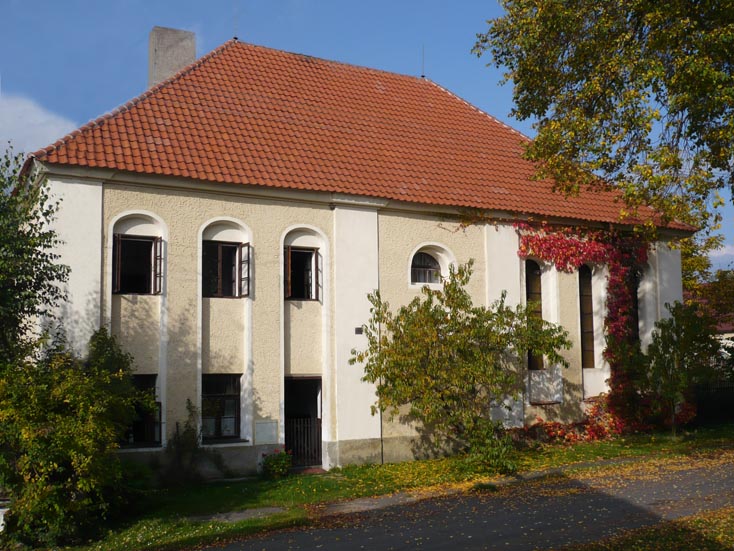
A Neo-Classical building from 1868 – one of the few surviving examples of rural Jewish architecture in south-western Bohemia.
History of the building
The original wooden synagogue stood in the centre of the ghetto on four load-bearing wooden columns. It was very small, measuring approximately 8 × 6 metres.
The new synagogue in Slatina is a free-standing, two-storey, simply Neo-Classical building with a hipped roof. The external dimensions are 18.9 × 11.4 m, with a height to the main cornice of 7 m. It was built in 1868 (according to some sources as early as 1850). Services were held here until 1912.
In September 1917, the last Jew left Slatina, and that same year merchant and music teacher Karel Volmut purchased the synagogue for 10,800 CZK. He enterprisingly converted the 'shul' into a general store and the prayer hall into a barn. After the Second World War he moved away, and the abandoned building served various purposes for the village and the newly formed Agricultural Cooperative. When the cooperative used the synagogue to store artificial fertilisers, its fate seemed sealed. Fortunately, after the merger of cooperatives, the then owner JZD Svéradice sold it in 1975, and the new owners restored it to its present form in 1983. Since 1958 the synagogue has been listed as a state cultural monument.
Technical data
- Dimensions: 18.9 × 11.4 m
- Height: 7 m (to cornice)
- Roof: Hipped, Dutch tiles
- Orientation: East (Jerusalem)
- Style: Neo-Classicism
- Built: 1868
- Windows: 8 large semicircular
- Address: Slatina 58
Description of the synagogue
Exterior and orientation
This brick building, quite imposing by village standards, was one of the few constructed outside the former ghetto, directly on the village square. The synagogue is oriented approximately in the direction of Jerusalem – to the east – as is the case with the vast majority of synagogues built in the diaspora. This tradition is broken in only a very few buildings. The temple walls are pierced by large semicircularly terminated windows spanning both floors. The interior decoration was very restrained. Synagogal art was expressed primarily through ornaments, symbols and script. Paintings have unfortunately survived only to a very small extent. One painting is above the spot where the Torah ark, called "aron ha-kodesh", was placed. On the façade above the entrance, two stone Tablets of the Law or another Hebrew inscription were likely displayed.
Ground floor – residential wing and mikveh
The entrance to the temple was likely located in the middle of the southern side of the building, which originally had two doorways on this side. The first was probably used solely for access to the western, residential part of the building, where the teacher's apartment and classroom were located. A small shop was built into the ground floor in 1917. One of the ground-floor rooms was apparently used as a kitchen – suggested by the outline of a black kitchen discovered during renovation of the room. According to some sources, there was also a matzah bakery here. The consumption of these unleavened breads (matzah, Hebrew: matzot) is rooted in the biblical tradition that Jews fleeing Egypt had to sustain themselves on flatbreads made from unleavened dough.
The ground floor also housed a Jewish ritual bath called a mikveh. The pool must hold at least 762 litres of water and be deep enough to allow full immersion of an adult; it was fed by flowing water from a natural spring. In ancient Israel, priests used the mikveh for ritual purification before serving in the Jerusalem Temple. Today the mikveh is used for the spiritual purification of women after the menstrual cycle, after childbirth or another blood discharge. Immersion in the mikveh is also an essential part of conversion to Judaism – it must be undergone by both male and female converts. Men generally visit the mikveh only during the High Holidays (Rosh Hashana and Yom Kippur) for spiritual preparation before these important Jewish festivals. The exact location of the mikveh has not been determined.
Behind the entrance doors opens a corridor with a barrel vault and segmental arches. On the right a staircase with a barrel vault leads to the first floor.
Vestibule and prayer hall
The second entrance was apparently the entry to an antechamber consisting of three small vaulted halls. The space was probably decorated with paintings and Hebrew inscriptions, among which the prayer "kaddish" spoke to arrivals: "For those who are here, and for those who are in any other place. May peace, mercy, grace and compassion be granted to them and to you…" Three arches, sprung from two massive granite columns, open this space into the prayer hall itself – a lofty room decorated with symbolic paintings.
Here Jewish men gathered at the end of each week – on Friday after the first star appeared and on the holy day of Sabbath – always wearing head coverings. On the eastern side, facing Jerusalem, stood the Torah ark (containing the Pentateuch – the Five Books of Moses, the oldest part of the Old Testament), called the aron ha-kodesh. The ark was permanently covered by a curtain called the "parochet". In the centre of the hall stood the reading platform called the almemor (bimah), from which the sacred Torah was read aloud; it was carried there from the ark before each service. The rabbi unrolled its text from a parchment scroll wound on two rollers. Outside of services it was always covered with a precious cloth.
From the almemor the rabbi also announced all religious, municipal and health commandments, as well as guidance on private and family life. The pews in their modern arrangement faced the ark and reading platform on the eastern wall.
Women's gallery
Women had no access to the consecrated part of the synagogue. So that they could at least passively observe the religious ceremonies, a space on the first floor was designated for them, open to the prayer hall through three openings with wooden railings and accessible only via a special external staircase on the northern side of the building.
Photo gallery
Historical and contemporary photographs of the synagogue building from the late 19th century. Photography: Petr Vápeník.




Photography © Petr Vápeník. Click on an image to view full size.