~1150
Village founded
Slatina was established around 1150. A monastic court operated here from 1220 to 1284.
Over two centuries of Jewish community life
in the heart of the Šumava foothills
For more than 1,000 years, Jewish communities have shaped the character of society in our territory. Their story is an inseparable part of Bohemian and Moravian history.
According to written records, the first Jewish merchants arrived in the Bohemian lands as early as the 10th century along trade routes from the south over the Alps and from the east via the Balkans. They first settled in commercial centres such as Brno, Olomouc, Znojmo and Prague.
They soon came into conflict with local guilds, which saw them as dangerous competition. Their existence and safety could only be secured by appealing for protection from rulers or feudal lords – which was extraordinarily costly. Constant attacks and pogroms led Jews to voluntarily or forcibly segregate into ghettos, but even those did not provide sufficient protection.
At the end of the 20th century, Bohemia and Moravia contained around 350 Jewish cemeteries, 313 synagogues and 77 historic Jewish settlements. Many were destroyed – first by pogroms, then by the Nazis, and afterwards by the Communists. Slatina is one of the places where this heritage has been preserved in a remarkably valuable form.
„Quiet places carry the loudest testimony."
From the village's founding to the flourishing of the Jewish community and its eventual end.
The Neo-Classical building from 1868 is one of the few surviving examples of rural Jewish architecture in south-western Bohemia.
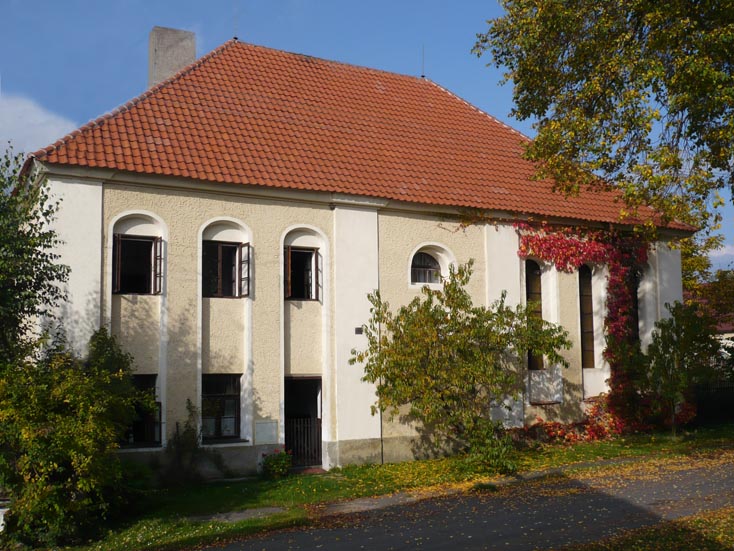
A two-storey Neo-Classical building with a hipped roof, oriented eastward towards Jerusalem in accordance with Jewish tradition. Dimensions: 18.9 × 11.4 m, height 7 m to the main cornice. Large semicircular windows illuminate both floors.
The Torah ark on the eastern wall – the holiest part of the synagogue.
The reading platform in the centre of the prayer hall, from which the Torah was read.
Ritual bath in the ground floor, fed by flowing water from a natural spring.
A separate space on the first floor, accessible via an external staircase.
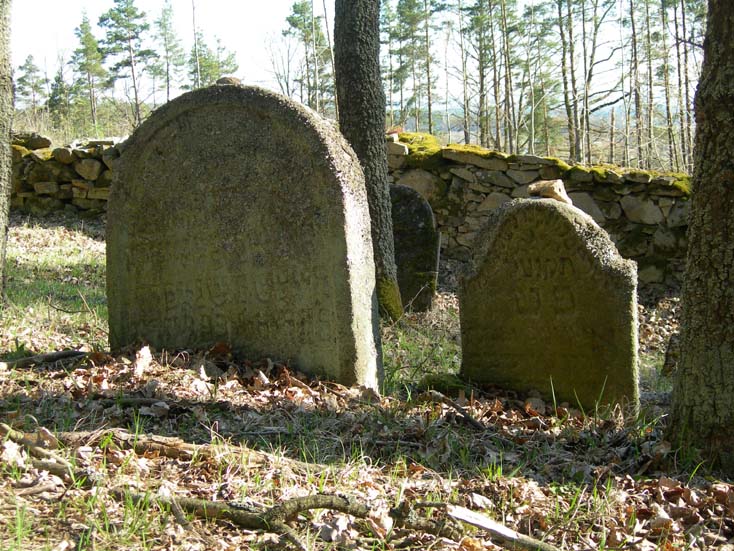
Hidden in a forest about 1 km north of Slatina lies the cemetery, with burials dating back to 1668.
The cemetery measures 58 × 28 metres (1,624 m²) and is surrounded by a 2-metre stone wall. It contains approximately 172 tombstones in Baroque and Neo-Classical styles – plain granite stelae and limestone headstones with arched tops and floral motifs.
Above the entrance gate was a Hebrew inscription: "House of assembly of all the living. Dust and earth you are, and to dust and earth you shall return." Burials took place at sunset in accordance with tradition. The last burial was in 1937.

Born on 4 April 1866 in Záboří u Blatné as one of eleven children. He emigrated to Chicago at age 15 with minimal means. He studied law and from 1907 continuously represented Illinois in the US Congress for 23 consecutive terms, becoming the second longest-serving congressman in US history.
„In 1918 he organised the triumphant reception of President T. G. Masaryk in Washington and became a key ally of Czechoslovakia in the US Congress."Full biography
Slatina is nestled in the picturesque Šumava foothills region. Plan a trip to see the Jewish heritage sites in person.
Slatina 58
Cultural monument no. 37216/4-3287
Approx. 1 km north of Slatina,
west of the road to Chanovice
The cemetery is freely accessible year-round. The synagogue is not publicly accessible – it is a private building. For a guided tour, please contact the Slatina Municipal Office.
South-western Bohemia has dozens of sites with significant Jewish cultural heritage – from Pilsen to Klatovy and Domažlice.
Maintaining the synagogue, cemetery and other monuments requires long-term care and funding. Your support helps preserve this unique testimony to intercommunal coexistence for future generations.
Contribute any amount to monument restoration and maintenance.
Help us with maintenance, documentation or event organisation.
Spread awareness of this place among your friends and family.